


Falls remain one of the most persistent threats to health and independence for older adults, and most fall risk assessments still rely on periodic, observation-based scoring. HealthPro Heritage's licensed therapists now pair that clinical judgment with objective, technology-supported gait and balance measurement through a partnership with Exer AI. The result is a way to identify risk earlier, build more targeted treatment plans, and give residents, families, and care teams a clear, measurable picture of progress over time. This paper explains the problem this addresses, how the approach works, and what it means for communities considering how to strengthen fall prevention efforts.
The Scope of the Problem
Falls are the leading cause of both fatal and nonfatal injury among adults age 65 and older.1 More than one in four older adults report falling each year,2 and about 37% of those falls result in an injury serious enough to require medical treatment or restrict daily activity.1 The financial impact is significant as well: nonfatal falls among older adults are estimated to cost the U.S. healthcare system tens of billions of dollars annually, a figure that has continued to climb as the population ages.3
For senior living and long-term care operators, these numbers translate into daily operational reality: staffing time, care planning, family communication, and, in some cases, liability exposure. Falls also shape how families evaluate a community in the first place. Prospective residents and their families consistently ask what a community is doing to reduce fall risk, and a vague answer does not build confidence.
Why Early Detection is the Missing Piece
Most fall risk programs are built around periodic, observation-based assessments. These are valuable, but they depend on a therapist's visual judgment at a single point in time and are not always repeated often enough to catch change as it happens. Balance and gait often begin to decline in measurable ways well before a fall occurs. Without a consistent, systematic way to track that decline, the window for early intervention frequently passes unnoticed.
Catching risk before it becomes a fall requires more than a snapshot. It requires a way to measure change over time, consistently and objectively.
The HealthPro Heritage Approach: Clinical Expertise Plus Objective Data
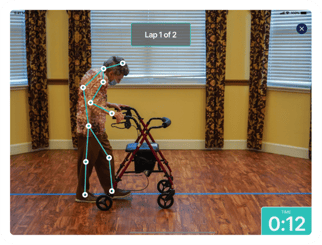 Through a partnership with Exer AI, HealthPro Heritage therapists now have access to AI-powered gait and balance assessment technology that runs on a standard iPad. There are no wearable sensors and no additional equipment to install. The assessment uses camera-based motion analysis, all processed on-device: no video is recorded or stored, and the platform is HIPAA compliant and FDA registered.
This technology does not replace clinical judgment. HealthPro Heritage therapists remain the ones interpreting results, building care plans, and working directly with residents. Exer AI gives them an additional, objective data point to bring into that process, so decisions are grounded in both clinical expertise and measurable evidence.
In practice, this means a therapist can assess a resident's gait and balance in real time, review the results with the resident on the spot, and use that data to shape a treatment plan that is specific to what the assessment shows, rather than a general protocol applied to everyone.
What Objective Measurement Enables
Bringing objective data into the fall prevention process changes what a therapy team can do with it. Instead of relying solely on observation, care teams can:
- Identify at-risk residents earlier, before a fall occurs.
- Build treatment plans around a resident's specific gait and balance profile, rather than a standard protocol.
- Track progress and spot potential decline objectively over time, using repeatable measurements rather than subjective impressions.
- Give residents and families a concrete, visual way to see improvement, which supports engagement in the plan of care.
What This Means for Your Community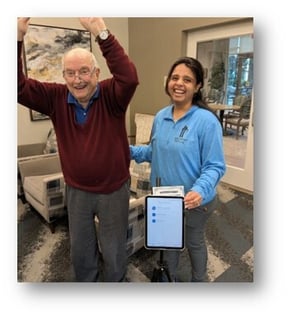
For senior living and long-term care operators, this approach offers two distinct benefits. Clinically, it strengthens an existing therapy relationship with a tool that adds precision without adding burden. From a positioning standpoint, it gives marketing and admissions teams something concrete to point to when families ask what a community is doing about fall risk, a question that comes up consistently in the decision-making process.
Because the assessment requires no special setup, it fits into existing therapy operations without disrupting a facility's care schedule.
Getting Started
For communities curious what this looks like in practice, a Balance Clinic is an easy first step: a short, on-site screening event that requires minimal setup - setting up an iPad. It's a low-commitment way to see the assessment firsthand before deciding whether it makes sense for your community.
To learn more about scheduling one, contact your HealthPro Heritage representative, or send us a note at info@healthpro-heritage.com.

References
1. Centers for Disease Control and Prevention, National Center for Injury Prevention and Control. “Facts About Falls.” Older Adult Fall Prevention. Available at cdc.gov/falls/data-research/facts-stats/index.html.
2. Kakara R, Bergen G, Burns E, Stevens M. “Nonfatal and Fatal Falls Among Adults Aged ≥65 Years — United States, 2020–2021.” MMWR Morbidity and Mortality Weekly Report. 2023;72:938–943. DOI: 10.15585/mmwr.mm7235a1.
3. Florence CS, Bergen G, Atherly A, Burns ER, Stevens JA, Drake C. “Medical Costs of Fatal and Nonfatal Falls in Older Adults.” Journal of the American Geriatrics Society. 2018;66(4):693–698. Figure as cited by the National Council on Aging, ncoa.org.